
@By Kumud Das
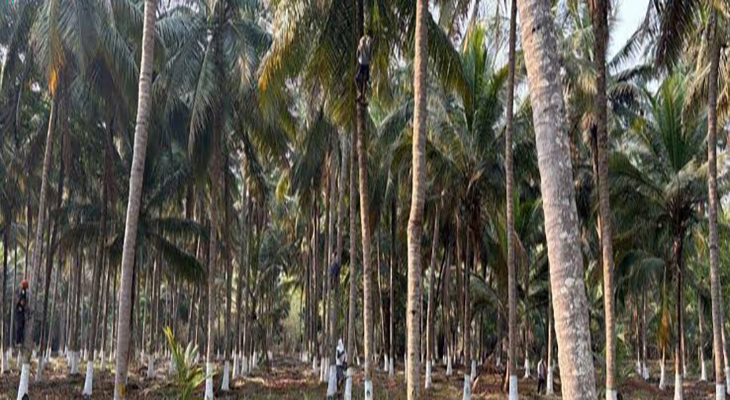
Chhattisgarh is known as the ‘Rice Bowl of India’, a landlocked region, far away from the country's coconut-growing coasts, is quietly expanding its agricultural identity beyond paddy. Chhattisgarh has none of the cultural associations with coconut that run through Kerala, Tamil Nadu or coastal Andhra Pradesh. Yet in Kondagaon district, in the heart of Bastar, coconut palms now rise from fields where few would have expected them to grow.
According to officials of the Coconut Development Board, its Kondagaon farm recorded the highest coconut production among all non-traditional Demonstration-cum-Seed Production farms in the country in 2025. Kondagaon is home to one of only 11 such farms established by the Coconut Development Board across India to promote scientific coconut cultivation and produce quality planting material. Much of this success can be traced to the Demonstration-cum-Seed Production Farm at Kondagaon. Established in 1987, with coconut planting beginning two years later, the farm is spread over 40 hectares and lies roughly 225 kilometers from Raipur. The farm’s laterite and sandy loam soils, with a pH ranging from 5.5 to 6.3, receive around 1,500 millimetres of rainfall annually. Irrigation from the Narangi River, a tributary of the Indravati, has also helped make coconut cultivation viable despite Chhattisgarh's inland location.
Field officials at the farm said the farm today maintains 5,306 coconut palms across tall, dwarf, hybrid and exotic varieties, of which 4,028 are in the yielding stage. In 2025-26 it harvested impressive 3,04,954 coconuts including 4,275 tender coconuts and produced 23,785 quality seedlings, while separately supplying 9,300 seed nuts to a sister DSP farm at Abhayapuri in Assam for further propagation.
Coconut is not the farm's only source of income. Mango, litchi, coffee, cinnamon, black pepper, cocoa and pineapple are grown as intercrops between the palms. Together, these crops generated an additional income of more than ₹7.53 lakh during that year. The farm's role extends beyond production. Through its 'Friends of Coconut Tree' programme, unemployed young people from Bastar have been trained in coconut-tree climbing and harvesting. The participants receive training, certification and climbing equipment free of cost, creating a local pool of skilled climbers where none existed earlier. The implementation of the Coconut Development Board's Kera Suraksha Insurance Scheme has also provided occupational insurance cover to coconut-tree climbers, harvesters and other workers associated with the sector. Sanket Kumar Panda, Field Officer, DSP Farm, Kondagaon says, “Coconut may be our main crop, but it’s the smart mix of intercrops: mango, litchi, coffee, cinnamon, black pepper, cocoa and pineapple—that truly strengthens our farm’s income.”
This year, besides harvesting over three lakh coconuts and producing nearly 24,000 seedlings, these intercrops alone brought in more than ₹7.53 lakh, showing that diversification is the key to sustainable farming even in non-traditional areas, he said.
India remains the world's largest coconut producer by a total number of nuts, accounting for 31.24 per cent of global production, with over 20,301 million nuts produced in 2024–25 according to DA&FW Statistics. Yet by total weight, the country stands third in the world. It also ranks third in area under cultivation, holding 17.90 per cent of the world's coconut-growing land. Altogether, nearly 30 million people across India, including close to 10 million farmers, depend on the coconut sector for their livelihood. During 2025–26, the Coconut Development Board brought around 2,175 additional hectares under cultivation nationwide. The Union Budget for 2026–27, presented earlier this year, also introduced a Coconut Promotion Scheme aimed at improving sustainability, strengthening exports and increasing farmers' incomes, an initiative now beginning to shape the sector's direction going into the current season.
But statistics alone cannot capture what this agricultural shift looks like on the ground. In Bakawand block, not far from the Kondagaon farm, 36-year-old MBA graduate Eshansh Singh Rathore manages a plantation of 2,500 coconut palms, most of them dwarf varieties. Around 500 of the palms have begun yielding. Coming from a farming family, Rathore once worked in the corporate sector. He later took up coconut cultivation systematically after receiving technical guidance from the Coconut Development Board. Between and around the coconut palms, he has planted 4,000 pineapple plants, 800 dragon-fruit plants, 1,000 mango trees and 600 citrus trees. He also grows bananas, guava, papaya, litchi, coffee and strawberry.
His coconut plantation alone earns him between ₹5 lakh and ₹6 lakh annually, while the intercrops contribute approximately ₹10 lakh more. Officials say his success has encouraged other farmers in Bastar to view coconut-based integrated farming as a model worth adopting. “The success of coconut cultivation in Kondagaon is an encouraging example of the agricultural possibilities in Chhattisgarh. The efforts of the Coconut Development Board have demonstrated that suitable scientific practices can enable farmers in non-traditional regions to take up coconut cultivation successfully. Such initiatives can open new avenues for agricultural diversification and strengthen livelihood opportunities for farmers in Bastar," said Chhattisgarh state Chief Minister, Vishnu Deo Sai.
For a state that made its agricultural name through paddy, the success of the Kondagaon farm—and the story of a Bakawand farmer now earning more from coconut and intercrops than he once earned in the corporate world—suggest something remarkable: Chhattisgarh's Rice Bowl is learning to grow a crop it was never expected to cultivate. Officials at the farm believe coconut cultivation has the potential to strengthen livelihood security and promote economic empowerment among Bastar's tribal communities. For Bastar, that could be a harvest worth watching.
A state with no coastline growing coconuts
October 01, 2026 04:27 PM
NEET UG 2026 Deemed Colleges - Round 1 Analysis
August 22, 2026 06:31 PM
Six Years of NEP 2020: Has Indian Higher Education Really Changed?
August 22, 2026 02:42 PM
Who Pays for India's Ethanol Transition?
August 18, 2026 12:43 PM
Hemang Palan interviews Gujarat’s Deputy Chief Minister
July 13, 2026 07:47 AM