
By Dr Siddharth Gavhale & Nikita Hajbe
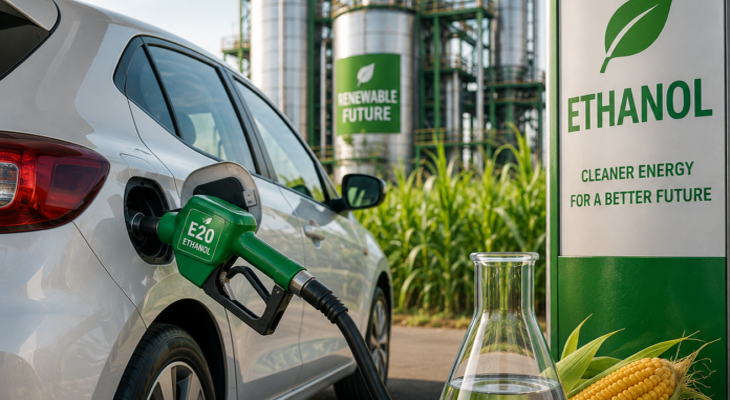
India's automobile industry, now one of the largest contributors to the country's economy, is in the middle of a fuel transition. More recently a second pathway has gained momentum: higher ethanol blends and the flex-fuel vehicles built to run on them. The harder question, and the one this article examines, is what the transition means for the roughly 44.36 crore vehicles already on Indian roads - the overwhelming majority of which were never designed for the blends now arriving at the pump. India's ethanol journey has moved through a series of steadily rising targets, from E5 to E10 to E20, the last of which the country reached in 2025, roughly five years ahead of its original 2030 deadline. According to NITI Aayog, most older vehicles in India were designed for E5 and could be calibrated to E10, while vehicles built from around April 2023 onward were engineered to run comfortably on E20. The pace has since quickened. On World Environment Day this year, the government launched E85 - a blend of 85 percent ethanol — at an initial 48 fuel outlets, with a stated target of 500 outlets by the end of 2026 and roughly 5,000 by 2027. A draft amendment to the Central Motor Vehicles Rules has moved to formally recognise E85 and E100 as automotive fuels. India intends to climb the ethanol ladder quickly.
The chicken-and-egg problem:
Higher blends such as E85 are designed for flex-fuel vehicles, which can run on anything from E20 up to E100. That creates a coordination problem. Fuel suppliers are reluctant to invest in separate storage and dispensing infrastructure until enough compatible vehicles exist, while consumers have little reason to buy a flex-fuel vehicle while the fuel is sold at only a handful of pumps. As of mid-2026 the gap was visible on both sides: flex-fuel passenger cars in India were still largely at the prototype stage even as the fuel began appearing at outlets. Whether vehicle supply and fuel supply can scale in step remains an open question.
Where the evidence pulls in different directions:
The government's position is firm. In written replies to the Rajya Sabha, the Ministry of Petroleum and Natural Gas has said that ethanol-blended petrol causes no significant compatibility problems, no significant variation in performance, and no abnormal wear and tear; including, it says, in older vehicles. The ministry points to field trials by the Indian Oil Corporation, the Automotive Research Association of India and the Society of Indian Automobile Manufacturers, which it says found no negative effect and even reported better acceleration and lower carbon emissions on E20 compared with E10. Set against that official assurance is a growing body of consumer reporting that tells a more complicated story. Owners of vehicles sold before the E20-compatibility cutoff have reported lower mileage and complaints such as rough idling, hard starting and clogged filters since the wider rollout. Independent guidance to motorists has repeatedly flagged ethanol's tendency to absorb moisture and the potential for corrosion in fuel systems not built for it; a concern that applies chiefly to older, non-compliant vehicles rather than newer certified ones. The mileage question illustrates the disagreement neatly. Ethanol carries less energy per litre than petrol, so some drop in fuel economy is expected on physical grounds. Industry estimates put the drop at around 2 to 4 percent, while the NITI Aayog's 2021 roadmap reported a larger gap of 6 to 7 percent for four-wheelers calibrated for E10. The government, meanwhile, maintains that any efficiency drop has been marginal and that claims of a drastic reduction are misplaced. The point worth emphasising is not that one side is lying. It is that a real gap exists between the official message of “no issue” and the experience reported by a section of vehicle owners; and that this gap deserves scrutiny rather than dismissal.

The insurance question:
Early in the rollout, media reports and a widely shared insurer statement created anxiety that engine damage from using E20 or E85 in an older vehicle might not be covered. The Ministry of Petroleum and Natural Gas has since clarified that the use of E20 does not affect the validity of a vehicle's insurance. But that clarification answers a narrower question than the one owners are actually asking. Standard motor policies do not cover gradual wear and tear — degradation of rubber parts, gaskets and seals over time — and it is exactly that kind of slow damage that a section of owners attribute to higher ethanol blends. And one step beyond: if higher blends were ever to contribute to a larger failure — the kind some owners describe online — would that be read as fuel-related damage, covered mechanical failure, or excluded wear? That question has not been squarely tested, and for the owner of a pre-2023 vehicle it is not an abstract one.
What it means for the household budget:
The effect on an ordinary owner's wallet has several moving parts. On running cost, ethanol's lower energy density means a vehicle may travel slightly less far on each litre; if the per-litre saving at the pump is smaller than the mileage penalty, the cost per kilometre can rise rather than fall. According to the NITI Aayog’s 2021 Ethanol Blending Roadmap, flex-fuel four-wheelers carry a price premium of ₹17,000 to ₹25,000, while two-wheelers cost ₹5,000 to ₹12,000 more than comparable conventional models. Brazil’s experience suggests that this premium can be brought down over time, but in the near term it sits on the buyer. There is a longer shadow too. If higher blends become the default and the lowest-ethanol options gradually vanish from pumps, owners of older vehicles face a narrowing set of choices: absorb the wear, retrofit where possible, or retire the vehicle earlier than they otherwise would. For many households a vehicle is among their most valuable assets, and a policy that accelerates its obsolescence transfers real value away from those with the least cushion.
Same destination, different road:
India's strategy openly draws on Brazil, the global benchmark for flex-fuel mobility. But the two journeys differ in a way that matters. Brazil's transition unfolded gradually over decades. Its National Alcohol Programme, launched in 1975, built ethanol production, vehicle adaptation and fuel distribution broadly in parallel, and the later arrival of flex-fuel vehicles let consumers move between blends without much worry. Today flex-fuel vehicles make up the large majority of new car sales there. Industry voices in India have themselves named two features of the Brazilian model as non-negotiable for success: competitively priced high-ethanol fuel, and the elimination of the cost premium on flex-fuel vehicles. India is pursuing similar ends on a far shorter timescale. The lesson from Brazil is not that ethanol is wrong for India. It is that sequencing matters. Where fuel, vehicles and consumer safeguards advance together, the road is smoother; where the fuel runs ahead of the fleet, the bumps tend to be felt by ordinary owners.
None of this disputes the national logic of ethanol. Lower crude imports, foreign-exchange savings, reduced emissions and extra income for farmers are real and significant gains. The question is narrower and fairer: as India moves quickly toward greener fuel, is the transition being managed so that its costs and benefits are shared — or is a meaningful part of the cost being borne, quietly, by the owner of the older vehicle who has the least room to absorb it? That is a question worth putting to policymakers, not because the destination is wrong, but because the route determines who pays the toll.
(The authors of this article are associated with Center for Interdisciplinary Studies & Research, D Y Patil International University, Pune. Views are personal)
લાઈક અને ફોલો કરો અમારું ફેસબુક પેજ FACEBOOK - AAJKAALDAILY
ફોલો કરો અમારું ઇન્સ્ટાગ્રામ INSTAGRAM - AAJKAALDAILY
સબસ્ક્રાઈબ કરો અમારી યૂ ટ્યૂબ ચેનલ YOUTUBE - AAJKAALDAILY
મહત્વના સમાચારો આપના મોબાઇલમા મેળવવા માટે જોડાઓ અમારા વોટ્સએપ ગ્રૂપમાં 99251 12230
View News On Application
ચીનના કિંગદાઓમાં આકર્ષક લાલ દરિયાકિનારો જોવા મળ્યો, મોટી સંખ્યામાં પ્રવાસીઓ ઉમટ્યા
October 20, 2026 08:12 PM

દિવાળી પહેલા સોનાના ભાવ ઘટ્યા, શું ધનતેરસ સુધીમાં હજુ સસ્તું થશે સોનું? જાણો
October 20, 2026 06:35 PM
ટાઈગર શ્રોફ ટાર્ગેટ નહોતો, મોટી સેલિબ્રિટીને મારવા આવ્યા હતા હુમલાખોરોઃ પૂછપરછમાં મોટો ખુલાસો
October 20, 2026 06:21 PM
અમેરિકાના વિદેશ મંત્રી રૂબીયોની એસ.જયશંકર સાથે મુંબઈમાં મુલાકાત, ટ્રેડ ડીલ પર આવી મોટી અપડેટ
October 20, 2026 06:14 PM